Evolve Collision Centers Updates Consumer Guidance on Collision Repair Estimates and Supplements
Ardmore, PA - August 31, 2026 - PRESSADVANTAGE - Evolve Collision Centers has updated its consumer guidance on

Press Release Disclaimer: This is a press release distributed through the XPR Media network. It has not been independently verified by our newsroom.

Ardmore, PA – August 31, 2026 – PRESSADVANTAGE –
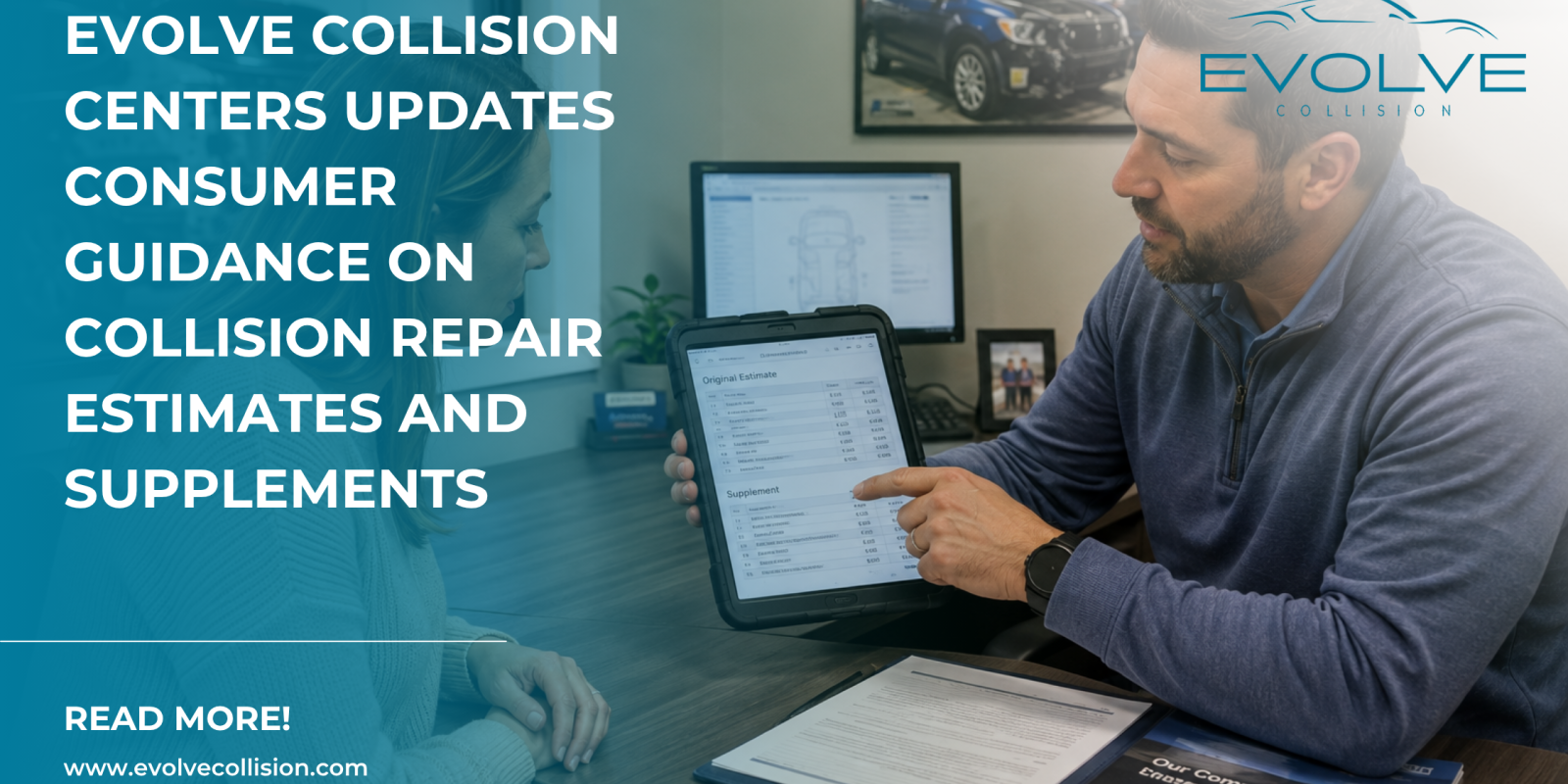
Evolve Collision Centers has updated its consumer guidance on collision repair estimates and supplements, adding a more defined explanation of how an initial estimate can develop into a detailed repair plan as additional vehicle information becomes available.
The August update specifically expands the company’s consumer information in three areas: what distinguishes an initial estimate from a supplement, what types of documented findings can lead to revisions, and how vehicle-specific repair procedures can introduce operations that were not identifiable during the first exterior inspection.
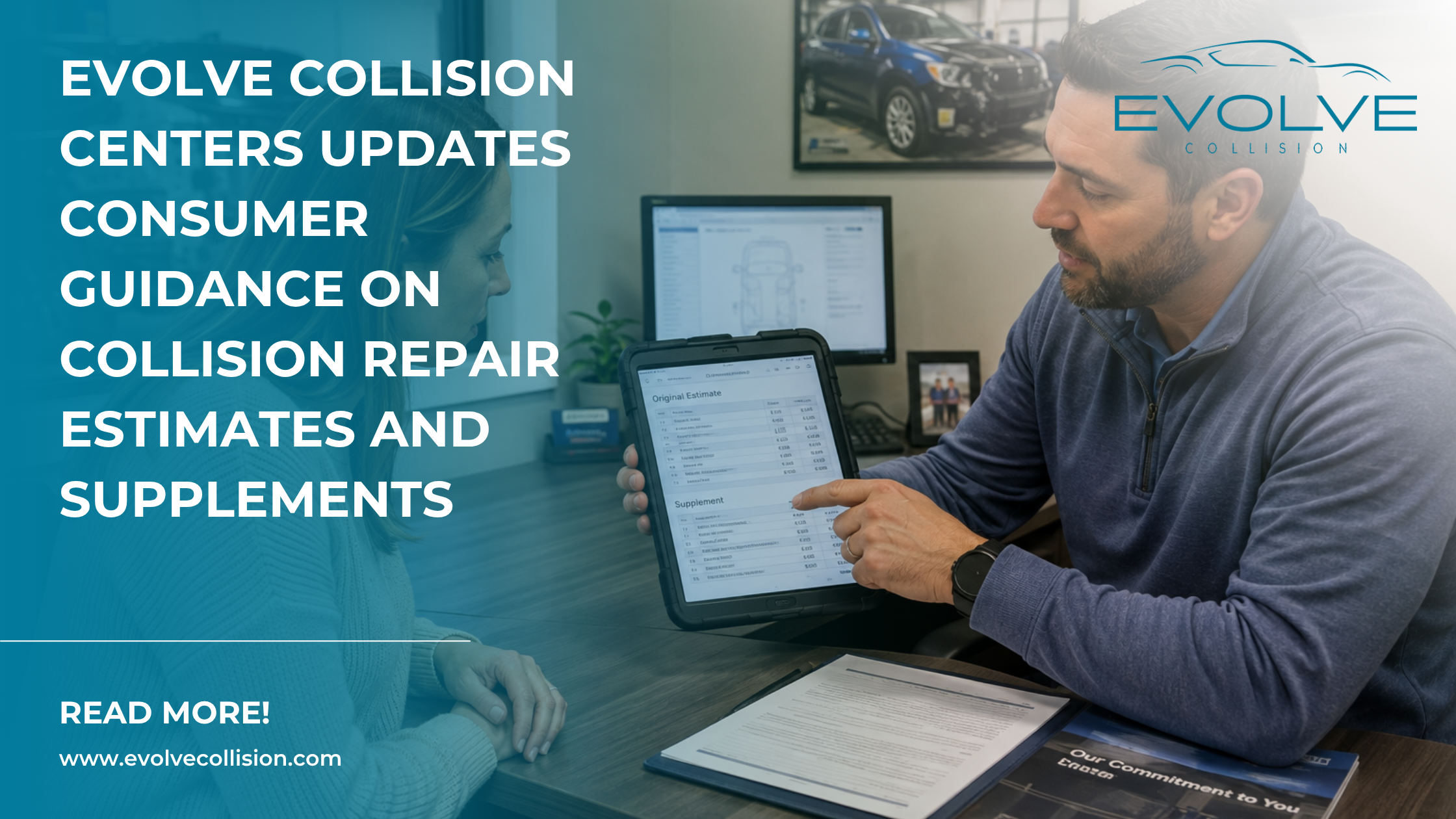
The updated guidance is intended to address a common question following an accident: why can the documented scope or cost of collision repair differ from the first estimate?
An initial estimate reflects information reasonably available when a vehicle is first evaluated. Visible damage involving bumper covers, fenders, doors, hoods, quarter panels, liftgates, lamps, glass, and other components can be documented along with information about the vehicle and the affected area.
Some portions of the vehicle, however, may not be fully accessible during that initial evaluation. Exterior components can cover brackets, mounting points, reinforcements, absorbers, wiring, fasteners, and adjacent parts.
The August update explains that this distinction is important when consumers compare an early estimate with repair information provided later in the process. An estimate records conditions identifiable at a particular stage. It does not necessarily establish every operation that will ultimately be required.
When appropriate component removal provides access to previously covered areas, technicians can evaluate their actual condition. If additional collision-related findings are documented, the repair plan can be revised to account for that information.
A collision repair supplement generally documents additional or revised repair information identified after the original estimate has been prepared. Depending on the circumstances, it can address newly documented damage, additional parts, changed repair operations, or technical procedures applicable to the repair.
The updated guidance emphasizes that a supplement does not automatically indicate that the original estimate was incorrect. Information available during an exterior inspection can differ from information available after technicians gain appropriate access to affected areas.
Evolve Collision Centers provides broader information about the evaluation and repair-planning process through its collision repair resource.
The August update also adds further context about vehicle-specific repair research and its relationship to estimates.
Modern vehicles can incorporate different grades of steel, aluminum, plastics, composites, adhesives, and electronic equipment. Vehicle manufacturers can publish technical information addressing component repairability, replacement requirements, attachment methods, joining procedures, measurements, corrosion protection, and other operations.
Research into applicable manufacturer procedures can therefore provide information that was not apparent from exterior damage alone.
For example, a damaged exterior component may need to be evaluated not only according to the visible size of the affected area but also according to its material, damage location, attachment areas, accessibility, and applicable manufacturer information.
The same principle applies when determining whether a component should be repaired or replaced. An initial visual assessment can document that damage exists, while additional evaluation and technical research can help establish which operation is appropriate for the individual component.
Bumper assemblies provide a useful example. A visible bumper cover can be associated with brackets, reinforcement components, absorbers, wiring, sensors, fasteners, and mounting locations positioned behind it. Appropriate access can establish the condition of those components when they are relevant to the collision.
This does not mean every damaged bumper will result in a supplement. The example illustrates why the information available during the first inspection can differ from information documented later.
Parts identification represents another area clarified in the updated guidance.
Modern vehicles can have different component configurations based on model year, trim level, installed technology, and production specifications. As affected areas are evaluated and applicable procedures are identified, the specific parts and associated hardware required for the repair can become more clearly defined.
When additional parts are supported by documented repair requirements, that information can be incorporated into the repair plan.
The August update also explains how advanced vehicle technology can affect estimating without assuming that every collision requires electronic procedures.
Cameras, radar units, parking sensors, wiring, and other advanced driver-assistance system components can be positioned in or near bumpers, windshields, mirrors, lamps, and other collision-affected areas.
When a repair involves these locations, vehicle-specific information can be reviewed to determine whether scanning, calibration, initialization, or another procedure applies. Requirements depend on the vehicle, affected system, repair operations, and manufacturer information rather than the presence of ADAS technology alone.
Additional information about these procedures is available through Evolve Collision Centers’ scanning and calibration resource.
Another addition to the August guidance is a clearer distinction between a supplement and the final repair record.
An initial estimate represents information available during an early stage of evaluation. A supplement documents supported changes or additions identified as repair planning progresses. The final repair documentation reflects the parts and operations associated with the completed work.
Separating these stages can help consumers understand why comparing only the dollar amount on an initial estimate with a later repair document does not provide the full context for a change.
The relevant question is what documented information changed.
Additional access may identify collision-related conditions that could not previously be evaluated. Manufacturer research may establish an applicable procedure. Parts identification may clarify components or hardware associated with the repair. Each circumstance can contribute additional information without implying that every repair will follow the same progression.
The updated guidance also addresses how supplements can relate to repair timelines. When new repair requirements are documented, additional planning may be needed before the corresponding work proceeds. Depending on the circumstances, this can involve parts identification, review of technical procedures, or coordination of updated repair information.
The publication does not establish a standard amount of additional time associated with a supplement. The effect on an individual repair depends on the findings, parts availability, required operations, and other circumstances specific to that vehicle.
For consumers reviewing updated repair documentation, Evolve Collision Centers recommends focusing on the reason for the revision rather than assuming that any change represents an error or unexpected expansion of the repair.
Understanding what condition was documented, which operation was added or changed, whether a component is being repaired or replaced, and what vehicle-specific information applies can provide clearer context for how the repair plan developed.
The August update is intended as consumer education rather than a prediction of repair costs, supplements, timelines, or insurance claim outcomes. Those factors can vary according to the vehicle, documented collision damage, repair requirements, parts availability, and insurer processes when applicable.
By expanding its guidance specifically around the progression from initial estimate to supplement and completed repair documentation, Evolve Collision Centers is providing consumers with a more focused explanation of a part of collision repair that can otherwise be difficult to interpret after an accident.
Additional information about collision-damaged exterior components is available through the company’s auto body repair resource.
Evolve Collision Centers operates from 2560 Haverford Rd, Ardmore, PA 19003.
About Evolve Collision Centers
Evolve Collision Centers provides collision and related automotive repair services, including auto body repair, paintless dent repair, refinishing, auto glass work, vehicle scanning and calibration, and OEM-certified repair capabilities. The company serves vehicle owners in Ardmore and surrounding Main Line communities.
###
For more information about Evolve Collision Centers, contact the company here:
Evolve Collision Centers
Butch Cantz
(267) 692-6699
bcantz@evolvecollision.com
2560 Haverford Rd, Ardmore, PA 19003