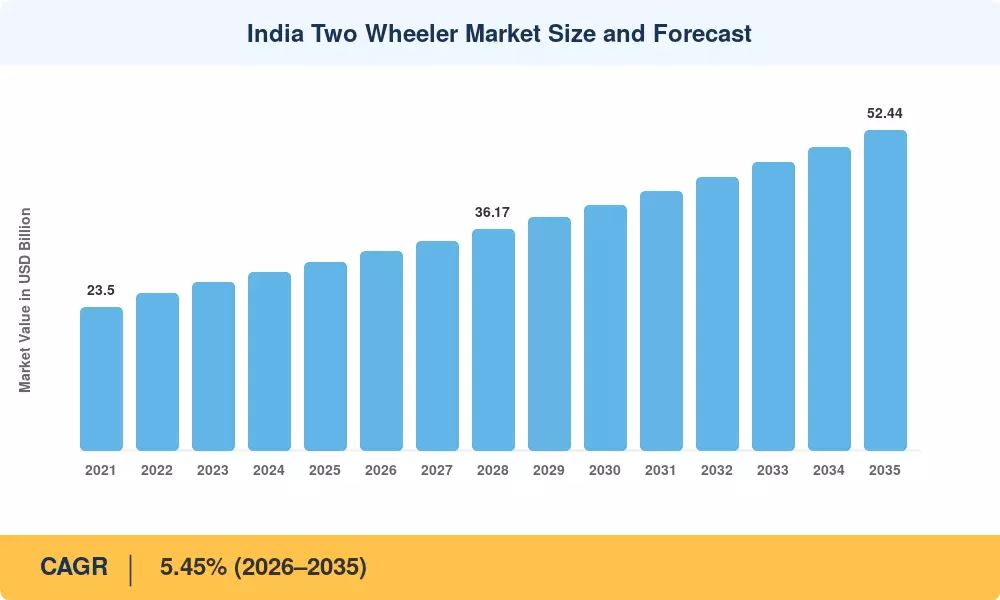
India Two-Wheeler Market to Reach USD 52.44 Billion by 2035, Growing at 5.45% CAGR
North India led the India Two Wheeler Market with an estimated 32% share in 2025, followed by West India at 26%. NEW

Press Release Disclaimer: This is a press release distributed through the XPR Media network. It has not been independently verified by our newsroom.

North India led the India Two Wheeler Market with an estimated 32% share in 2025, followed by West India at 26%.
NEW YORK, NY, UNITED STATES, August 31, 2026 /EINPresswire.com/ — According to Market Research Future, the India Two-Wheeler Market is projected to grow from USD 32.53 Billion in 2026 to USD 52.44 Billion by 2035, registering a CAGR of 5.45% across the forecast period (2026–2035). This steady growth reflects the structural transformation of India’s largest automotive segment, where the traditional mass-market motorcycle model is being reshaped by rising urban demand, accelerating premiumisation, and the rapid electrification of scooters. With domestic wholesale volumes reaching an all-time high of approximately 22 million units in FY2026, the India Two-Wheeler Market is scaling new peaks while undergoing fundamental shifts in demand composition that favour scooters, electric vehicles, and higher-displacement motorcycles . The India Electric Scooter Market is emerging as a key driver of this transformation, with electric two-wheelers positioned as the single largest driver of the country’s EV transition .
Market Overview
India’s two-wheeler market is one of the largest in the world, serving as the primary mode of personal transportation for millions of households across urban and rural India. The market encompasses motorcycles, scooters, and mopeds powered by internal combustion engines and increasingly by electric powertrains. With domestic volumes growing from approximately 18 million units in FY2024 to 22.3 million in FY2026, the industry continues to operate at extraordinary scale . However, recent growth masks a more fundamental structural shift—incremental demand is no longer being driven by the traditional mass-market petrol motorcycle, but increasingly by scooters and early-stage electrification .
The key growth drivers propelling this market expansion include rapid urbanisation and limited public transport options, which have boosted demand for personal mobility solutions across metropolitan and Tier-1 cities . Rising disposable incomes and evolving consumer aspirations are driving premiumisation across both motorcycles and scooters, with consumers upgrading to feature-rich, higher-displacement vehicles . Government policy support, including the FAME scheme, the PLI Auto programme, and GST rationalisation, has created a favourable environment for both conventional and electric two-wheeler adoption . The growing commercial demand from e-commerce, food delivery aggregators, and two-wheeler taxi operators is creating a robust B2B segment that absorbs significant volumes .
Technological developments are reshaping the two-wheeler landscape at an accelerating pace. The shift toward electric mobility is transforming the product portfolio, with manufacturers investing in lithium-ion battery technology, connected features, and advanced telematics . Premiumisation is driving demand for higher-capacity engines, advanced safety features, and digital instrument clusters across both ICE and electric segments. The expansion of battery-swapping ecosystems and charging infrastructure is addressing range anxiety and accelerating EV adoption .
Market Segmentation
The India two-wheeler market is segmented based on vehicle type, propulsion, engine capacity/motor power, price band, end-user, and sales channel to provide comprehensive insights into the industry landscape.
By Vehicle Type: The market is categorized into Motorcycles and Scooters. Scooters have emerged as the dominant growth driver, with penetration hitting a record 36% in YTD FY26, surpassing the previous peak of approximately 33%. Adjusted for unreported electric two-wheeler volumes, scooter penetration climbs further to 38.4% . Scooter volumes have outpaced the broader two-wheeler industry, recording a 4.1% CAGR from FY20-25 . The shift is driven by rapid urbanisation, limited public transport options, and sustained demand from e-commerce and delivery services .
By Propulsion: The market is divided into Internal Combustion Engine and Electric segments. Electric two-wheelers are the fastest-growing category, with retail registrations reaching 970,993 units in H1 2026, up 53.3% year-on-year . The segment is on track to approach 2 million annual sales for the first time, with electric two-wheelers now accounting for 8.17% of India’s two-wheeler sales . However, EVs remain modest at 3.3% penetration for FY2026 overall, indicating significant headroom for growth . Electric scooters dominate the EV segment with approximately 68% market share, while electric motorcycles are projected to grow at approximately 20.2% CAGR through 2035 .
By Engine Capacity / Motor Power: The market serves multiple segments from Up to 110cc through Above 250cc for ICE vehicles, and Up to 1.1 kW through Above 3.0 kW for electric vehicles. The 100-125cc segment leads market share by delivering an optimal balance between operational efficiency and performance adequacy for typical Indian usage patterns . However, premiumisation is driving growth in higher displacement categories—the 350cc segment has reached an all-time high of 5.7% of total two-wheeler volumes and 36% of premium motorcycle sales, up sharply from 2% and 16% respectively in FY15 . In metros and Tier-1 cities, 125cc scooters command 45-50% share, driven by feature-rich offerings . The above 60V segment in electric two-wheelers is anticipated to grow at 19.6% CAGR, reflecting demand for premium performance-oriented EVs .
By Price Band: The market is segmented into Up to USD 1,000, USD 1,001–1,500, USD 1,501–2,000, and Above USD 2,000 categories, accommodating diverse consumer budgets from entry-level commuters to premium aspirational buyers. The premium segment is emerging as the key growth engine, supported by aspirational demand and new product launches .
By End-User: The market serves B2C (Personal) and B2B (Delivery & Logistics) segments. Personal constitutes the market majority, driven by Indian consumer aspirations for individual mobility and lifestyle convenience . Commercial demand from e-commerce, delivery services, and two-wheeler taxis is a significant growth driver .
By Sales Channel: The market is categorized into Offline (Dealer Network) and Online channels. Offline continues to dominate, driven by consumer preference for tangible engagement, test rides, and after-sales services. Dealerships provide critical financing, insurance, and legal documentation bundled into a convenient purchase journey .
🛒 You can buy this market report at:
https://www.marketresearchfuture.com/checkout?currency=one_user-USD&report_id=21400
Competitive Landscape and Key Players
The India two-wheeler market is highly competitive, featuring a mix of established legacy OEMs, emerging EV specialists, and innovative startups. The competitive landscape is characterized by product diversification, technological innovation, and expanding distribution networks.
Key players operating in this market include Hero MotoCorp, Honda Motorcycle & Scooter India, TVS Motor Company, Bajaj Auto Limited, Suzuki Motorcycle India, Yamaha Motor India, Royal Enfield, Ola Electric, Ather Energy, Greaves Electric Mobility, River, and BGauss .
Strategic developments are reshaping the competitive landscape. Hero MotoCorp, despite holding approximately 42% market share in motorcycles, remains underexposed to scooters (approximately 6.6%) and electric two-wheelers . However, the company has emerged as the industry’s biggest EV breakout story, with H1 2026 registrations more than tripling to 104,417 units . TVS Motor Company continues to be India’s largest electric two-wheeler manufacturer, registering 251,438 units during H1 2026 with 65.7% year-on-year growth .
The electric two-wheeler market is consolidating around established manufacturers. TVS, Bajaj, Ather, and Hero together accounted for 95.6% of incremental registrations in H1 2026, with combined market share increasing from 66.6% to 76.7% . However, a middle layer comprising Greaves Electric Mobility, River, and BGauss is emerging, contributing 58.4% of incremental sales and suggesting India’s EV market is evolving from one dominated by a handful of manufacturers into one with a broader competitive base .
Innovation and technology initiatives are accelerating across the industry. Companies are investing in lithium-ion battery technology, connected mobility platforms, and advanced telematics to differentiate their offerings . The industry is moving toward advanced battery technology, connected mobility, and higher demand for lithium-ion battery-powered scooters because they are more efficient, have longer mileage, and cost less to maintain . Legacy OEMs are expanding EV portfolios while EV specialists are strengthening distribution and service networks, creating a competitive environment where scale, brand, and network are becoming decisive factors .
Market Challenges and Opportunities
The India two-wheeler market faces several key challenges that could impact growth trajectories. Battery price volatility affects company profitability and consumer purchasing patterns, while reliance on imported battery cells and critical minerals creates supply chain vulnerabilities . Inadequate charging infrastructure in cities and rural areas can limit EV adoption, and regulatory compliance related to battery safety and recycling adds complexity for manufacturers . Geopolitical risks, including tensions in West Asia, could disrupt supply chains and exports, warranting close monitoring by industry players . The 100-125cc engine capacity segment currently leads the market, but sub-125cc segments are expected to continue declining as premiumisation gains momentum .
Emerging opportunities are abundant in the evolving mobility landscape. The rapid urbanisation and growing demand for sustainable urban mobility solutions present significant opportunities for companies offering affordable, efficient two-wheelers with good battery range and digital connectivity . Shared mobility and battery-swapping ecosystems could be significant in the future, especially in crowded cities . Companies that invest in connected mobility platforms and advanced telematics can build strong customer relationships and generate recurring revenue . The expansion of electric two-wheelers in B2B applications, including delivery and logistics fleets, presents a significant growth opportunity supported by favourable running-cost economics .
To explore more market insights, visit us at:
https://www.marketresearchfuture.com/reports/india-two-wheeler-market-21400
Final Market Summary
The India two-wheeler market is positioned for steady growth, driven by urbanisation, premiumisation, and the accelerating transition to electric mobility. The market’s trajectory from USD 32.53 Billion in 2026 to USD 52.44 Billion by 2035 reflects the fundamental transformation of India’s largest automotive segment from a mass-market commodity business to a diversified, technology-driven mobility ecosystem.
The long-term industry potential remains strong, with advancements in battery technology, connected features, and premium product offerings continuing to expand the addressable market. The convergence of two-wheelers with broader mobility ecosystems, including shared mobility platforms, battery-swapping networks, and digital connectivity, is creating comprehensive solutions that serve diverse customer needs across urban and rural India.
Key factors expected to influence future development include the pace of electric vehicle adoption, the evolution of government policies and subsidy frameworks, and the expansion of charging and battery-swapping infrastructure. The development of affordable, reliable electric two-wheelers with good range and digital connectivity will accelerate EV adoption across consumer and commercial segments. Structural drivers such as GST rationalisation, replacement demand, and rising urban aspiration will continue to support long-term growth even as near-term volatility from monsoon variability and geopolitical risks persists .
The transformation from a predominantly ICE-powered mass-market industry to a diversified market encompassing electric, premium, and connected two-wheelers represents a fundamental industry evolution, positioning India’s two-wheeler market as a critical component of the country’s sustainable mobility future. As consumers continue to trade up, the share of sub-125cc vehicles is expected to shrink further, cementing premiumisation as the long-term growth engine of India’s two-wheeler industry .
More Related Reports from MRFR Library:
Patient Lift Equipment MRO Services Market : https://www.marketresearchfuture.com/reports/patient-lift-equipment-mro-services-market-67512
Pharmaceutical Storage Equipment MRO Services Market : https://www.marketresearchfuture.com/reports/pharmaceutical-storage-equipment-mro-services-market-67554
Refrigeration Equipment MRO Services Market : https://www.marketresearchfuture.com/reports/refrigeration-equipment-mro-services-market-67697
Rolling Stock Maintenance Services Market : https://www.marketresearchfuture.com/reports/rolling-stock-maintenance-services-market-67764
Ship Electrical Power Systems MRO Services Market : https://www.marketresearchfuture.com/reports/ship-electrical-power-systems-mro-services-market-67805
Ship HVAC Systems MRO Services Market : https://www.marketresearchfuture.com/reports/ship-hvac-systems-maintenance-and-mro-services-market-67810
E Bike Market : https://www.marketresearchfuture.com/reports/e-bike-market-1876
Automotive Wiring Harness Market : https://www.marketresearchfuture.com/reports/automotive-wiring-harness-market-2408
Catalytic Converter Market : https://www.marketresearchfuture.com/reports/catalytic-converter-market-2980
Electric Bicycles Market : https://www.marketresearchfuture.com/reports/electric-bicycles-market-4186
Market Research Future
Market Research Future
+1 855-661-4441
email us here
Legal Disclaimer:
EIN Presswire provides this news content “as is” without warranty of any kind. We do not accept any responsibility or liability
for the accuracy, content, images, videos, licenses, completeness, legality, or reliability of the information contained in this
article. If you have any complaints or copyright issues related to this article, kindly contact the author above.

Media gallery