
MoneySimpler Examines How AI May Help Investors Reduce Emotional Decision-Making
NEW YORK, August 9, 2026 — Market volatility can make investment decisions difficult even for experienced investors.

Press Release Disclaimer: This is a press release distributed through the XPR Media network. It has not been independently verified by our newsroom.
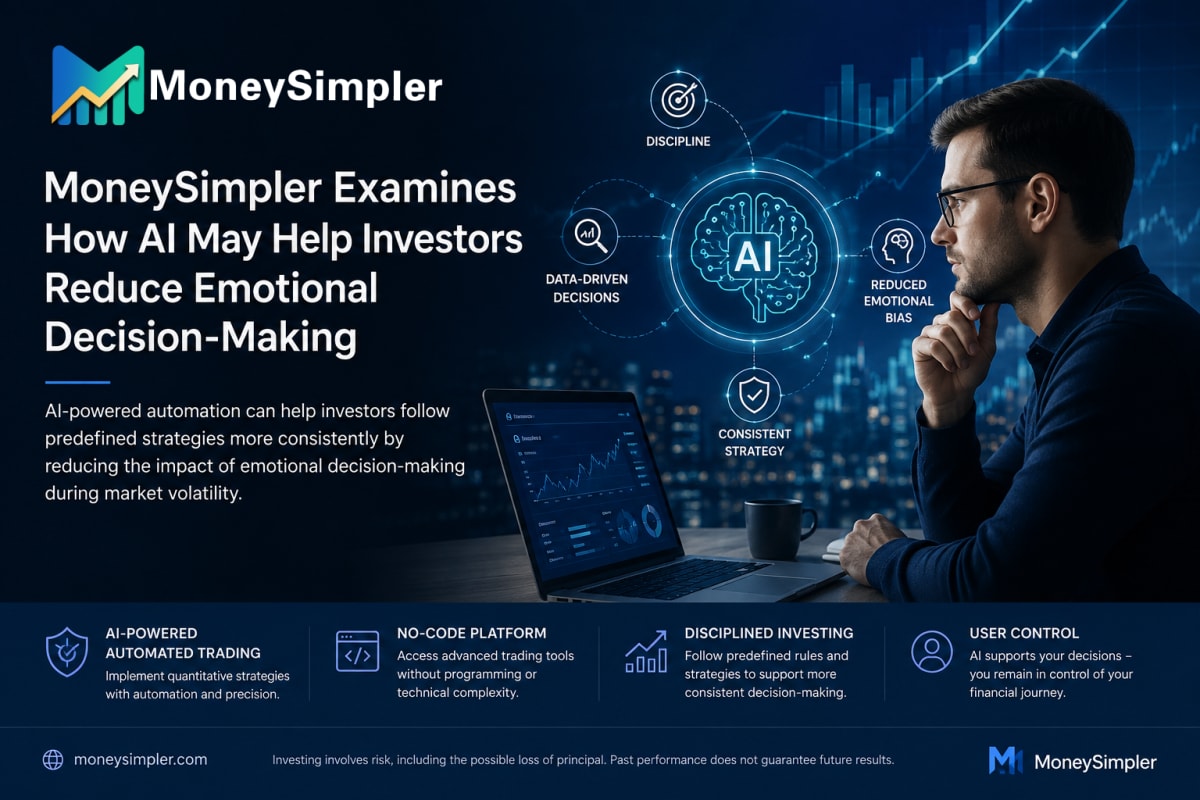

NEW YORK, August 9, 2026 — Market volatility can make investment decisions difficult even for experienced investors. When prices move sharply, fear, excitement, and uncertainty can influence how individuals respond to changing conditions. As artificial intelligence becomes increa…
NEW YORK, August 9, 2026 — Market volatility can make investment decisions difficult even for experienced investors. When prices move sharply, fear, excitement, and uncertainty can influence how individuals respond to changing conditions. As artificial intelligence becomes increasingly integrated into financial technology, automated systems are providing investors with new tools designed to support more consistent, rules-based decision-making.
Emotional decision-making has long been recognized as a challenge in investing. During periods of market optimism, investors may become more willing to take risks or follow rapidly rising assets. During periods of uncertainty, the opposite reaction can occur, with investors making decisions based on short-term concerns rather than their broader financial objectives.
These behavioral patterns can make it difficult to maintain a consistent investment strategy. Investors may change their plans in response to headlines, sudden price movements, or changes in market sentiment, even when those actions do not align with their original strategy.
Artificial intelligence and automation offer one potential way to address part of this challenge. Rather than relying entirely on manual decisions, automated systems can operate according to predefined rules and parameters. This allows certain investment processes to continue without requiring users to make a new decision every time market conditions change.
The growing use of AI across financial services is also contributing to this shift. Financial institutions are increasingly exploring AI for analytics, forecasting, customer services, and other applications, reflecting a broader move toward technology-assisted financial decision-making.
“Investment decisions can become particularly challenging when markets are moving quickly,” said HUSSAIN, Intizar, Chief Executive Officer of MoneySimpler. “AI-assisted automation can help investors follow predefined strategies more consistently, but it should be viewed as a decision-support tool rather than a replacement for individual judgment.”
MoneySimpler provides an AI-powered automated trading platform designed to help users implement quantitative investment strategies through a simplified, no-code interface. By automating selected processes according to predefined parameters, the platform is designed to reduce the need for users to manually monitor and respond to every short-term market movement.
However, automation does not eliminate emotional or financial risk entirely. Investors remain responsible for selecting strategies, understanding potential risks, and determining whether an automated approach is appropriate for their financial circumstances. AI systems also cannot predict every market event or guarantee a particular outcome.
The role of AI in investing may therefore be less about removing human involvement and more about helping investors establish greater discipline around their investment processes. By automating repetitive actions and following predetermined rules, technology can provide a framework that may make it easier for investors to maintain consistency during periods of market uncertainty.
As financial technology continues to evolve, behavioral considerations are likely to remain an important part of the discussion surrounding AI-assisted investing. Technology can process information and execute predefined instructions, but investors must still determine their financial goals, risk tolerance, and appropriate investment approach.
MoneySimpler views the development of AI-assisted automation as part of a broader effort to make investment technology more accessible while encouraging disciplined decision-making. The company emphasizes that technology should complement informed financial judgment rather than replace it.
Investment Risk Disclosure
Investing involves risk, including the possible loss of principal. AI-powered trading systems and automated strategies do not guarantee profits or eliminate market risk. Past performance does not guarantee future results. Investors should carefully evaluate their financial objectives, financial circumstances, and risk tolerance before making investment decisions.
About MoneySimpler
MoneySimpler is a financial technology platform focused on AI-powered automated trading. Through its no-code platform, users can access quantitative investment strategies and AI-assisted trading tools without requiring programming knowledge or complex technical configuration.
###
Media Contact
Company: MoneySimpler
Contact Person: Alice Davies
Email: Send email
Website: moneysimpler.com
Title: Media Contact

