
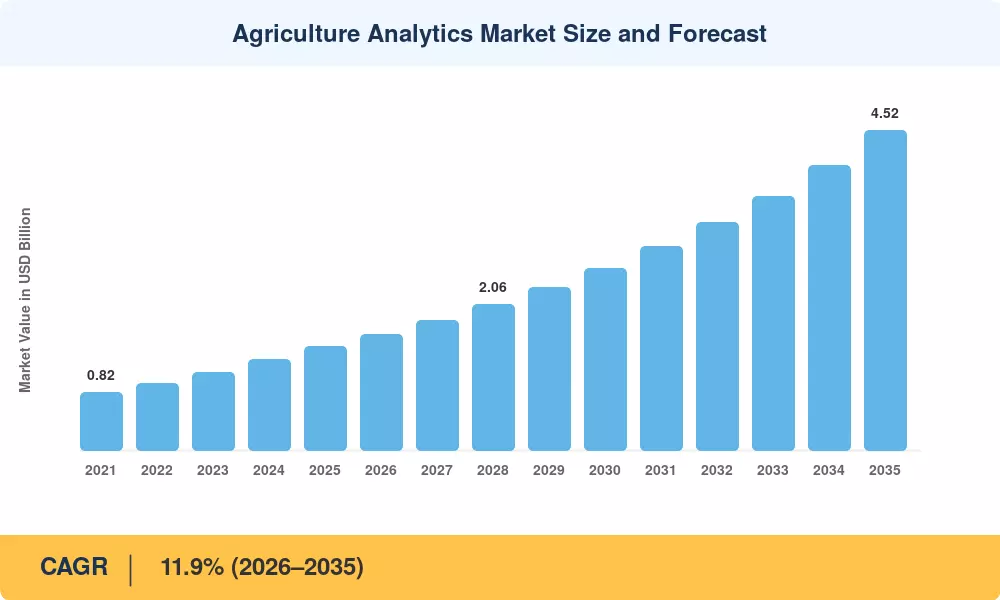
Agriculture Analytics Market Projected to Hit USD 4.52 Billion at a 11.9% CAGR by 2035
Agriculture Analytics Market uses AI and data-driven insights to improve crop productivity, optimize resources, and

Press Release Disclaimer: This is a press release distributed through the XPR Media network. It has not been independently verified by our newsroom.

Agriculture Analytics Market uses AI and data-driven insights to improve crop productivity, optimize resources, and enable precision farming.
NEW YORK, NY, UNITED STATES, August 6, 2026 /EINPresswire.com/ — The Agriculture Analytics Market is entering a decisive growth phase as farms of every size move away from spreadsheet-driven planning toward connected, data-led decision-making. By combining satellite imagery, IoT field sensors, and machine-learning models, modern platforms are giving growers real-time visibility into soil health, crop performance, and livestock welfare. This shift is reshaping farm management from a largely experience-based practice into a measurable, software-supported discipline that spans crop production, livestock operations, and aquaculture.
The agriculture analytics market was valued at approximately USD 1.47 billion in 2025 and is on track to reach USD 1.64 billion in 2026, before climbing to USD 4.52 billion by 2035, expanding at a CAGR of 11.9% across the 2026-2035 forecast window. This trajectory is being driven by large-scale government food-security programs, most notably India’s Digital Agriculture Mission, alongside a steady rise in venture funding for precision-farming data platforms. Sustained investment from public agencies such as the USDA, whose climate-smart commodities partnerships have already committed billions of dollars since 2023, continues to accelerate adoption of soil-monitoring tools and digital decision-support systems, particularly across North America.
Get a Sample PDF of the Report at –
https://www.marketresearchfuture.com/sample_request/10403
Market Dynamics: Drivers, Restraints and Opportunities
Growth in this market is anchored in the rapid spread of precision-farming technology and IoT-enabled field devices. The cost of agricultural sensors has fallen sharply over the past several years, pushing the global installed base of connected field equipment to past 50 million units. That density of data, covering everything from soil moisture to crop health, feeds directly into farm management systems, and platforms operated by major equipment makers now process hundreds of millions of acres of agronomic data annually. Regulatory momentum is reinforcing this trend: initiatives such as India’s national agri-data stack and the European Union’s revised Common Agricultural Policy, which ties a meaningful share of direct payments to satellite-verified sustainability reporting, are converting what was once optional analytics adoption into a compliance requirement.
Advances in artificial intelligence are also reshaping the economics of the sector. Deep-learning models used for crop-yield forecasting have become markedly more accurate over the past several years, and that precision gain changes the return-on-investment calculation for farmers weighing subscription-based software against traditional guesswork. At the same time, escalating climate volatility and a documented rise in insured agricultural losses are pushing crop insurers to mandate or incentivize the use of weather-indexed risk models and soil-health monitoring tools.
Even so, the market faces real friction. Roughly a third of the world’s population, concentrated heavily in rural farming regions, still lacks dependable internet access, which shuts many climate-vulnerable smallholders out of cloud-based analytics platforms. Uncertainty around who owns and profits from farm-level data is another persistent restraint, compounded by evolving privacy regulations in the EU and India. High subscription costs also remain a barrier for the hundreds of millions of smallholder farms that make up the bulk of global farm holdings but only a small fraction of total farmland.
These challenges are, in turn, opening new opportunities. Mobile-first, pay-per-insight platforms are emerging to serve smallholders through low-bandwidth channels, while the growth of voluntary carbon markets is turning verified, analytics-backed carbon data into a potential new revenue stream for farms rather than just a cost center. The rapid expansion of autonomous farm equipment, expected to become a multi-billion-dollar category by the end of the decade, is also creating demand for real-time decision layers that plug directly into machine-control systems, alongside a wider push toward end-to-end supply-chain traceability driven by sustainability regulation in the EU and Japan.
Key Players and Competitive Insights
The competitive landscape spans equipment manufacturers, agri-input conglomerates, and specialized software vendors, each pursuing a distinct data strategy. Deere & Company leads through its vertically integrated Operations Center and computer-vision-based spraying systems, while Bayer’s Climate FieldView positions itself as an input-agnostic data platform. Corteva Agriscience, Trimble Inc., BASF Digital Farming, and CNH Industrial round out the group of established players building analytics directly into their equipment and crop-protection ecosystems, while CropIn Technology, Farmers Edge, Agri Webb, and Syngenta Group represent the growing wave of software-first specialists targeting emerging markets, livestock management, and sustainability reporting, respectively.
The overall field remains moderately fragmented, with the leading five companies together holding roughly a third of global revenue, leaving considerable room for platform consolidation as equipment OEMs, agri-input majors, and cloud hyperscalers compete to become the operating system of digital farming.
Buy this Premium Research Report at –
https://www.marketresearchfuture.com/checkout?currency=one_user-USD&report_id=10403
Market Segmentations
By Component
• Software Solutions
• Services (Managed & Professional)
• Hardware (Sensors & Edge Devices)
By Farm Size
• Large Farms
• Medium-Sized Farms
• Small Farms
By Deployment Mode
• Cloud-Based
• On-Premises
• Hybrid
By Application
• Farm (Crop) Analytics
• Livestock Analytics
• Aquaculture Analytics
• Forestry & Specialty Crop Analytics
Regional Insights
North America holds the largest share of the global market, close to 38%, supported by mature broadband infrastructure, large average farm sizes, and strong federal programs such as USDA Climate Hubs and Conservation Innovation Grants that have funded analytics pilots across dozens of U.S. states. Europe ranks second with roughly 27% share, propelled by the reformed Common Agricultural Policy, which links a portion of subsidy payments to digital sustainability reporting, along with continued research funding through the EU’s Horizon Europe program.
Asia-Pacific is the fastest-expanding region, growing at an estimated CAGR near 14.8%, as government digitization campaigns in China and India, including China’s network of state-backed smart-agriculture pilot zones and India’s Agri Stack digital-identity initiative, bring millions of previously undocumented farms into data-driven systems. South America, led by Brazil’s soybean, sugarcane, and cattle supply chains, and the Middle East & Africa, where Saudi Arabia’s Vision 2030 food-security investments and mobile-based advisory services in East Africa are gaining traction, represent smaller but fast-growing markets with substantial long-term potential.
Browse A Full Report: (Including Full TOC, List Of Tables & Figures, and Chart) –
https://www.marketresearchfuture.com/reports/agriculture-analytics-market-10403
Recent Developments
Deere & Company expanded its See & Spray Ultimate system to soybean and cotton fields, using real-time computer-vision analytics to cut herbicide use substantially on treated acres. Bayer Crop Science integrated Climate Field View with a major cloud provider’s farm-data platform, letting growers combine satellite, weather, and sensor data in one dashboard.
Crop In Technology raised a Series C extension to expand its AI-powered crop-monitoring platform across Southeast Asia and East Africa. The European Commission finalized implementing rules for CAP eco-scheme digital reporting, creating mandatory demand for geo-tagged analytics across millions of EU farm holdings.
The USDA launched the second phase of its Partnerships for Climate-Smart Commodities program, committing over a billion dollars to projects that include farm-level analytics components. Syngenta Group rolled out a sustainability-tracking module to help growers report on-farm carbon intensity to downstream food companies.
Trimble Inc. acquired a French AI-based weed-detection startup to strengthen real-time precision-spraying analytics across European markets. India’s government piloted its AgriStack digital framework across 100 districts, linking farmer IDs, land records, and crop data for analytics-driven agricultural extension.
Frequently Asked Questions (FAQs)
Q1. How big is the agriculture analytics market expected to become by 2035?
The market is projected to grow from USD 1.47 billion in 2025 to USD 4.52 billion by 2035, at a CAGR of 11.9%.
Q2. What is driving growth in the agriculture analytics market?
IoT sensor proliferation, government digital-agriculture mandates, AI-driven yield forecasting, and rising demand for climate-risk management are the primary growth drivers.
Q3. Which region leads the agriculture analytics market?
North America currently holds the largest share, at roughly 38% of global revenue, due to mature infrastructure and strong precision-agriculture adoption.
Q4. Which region is growing the fastest?
Asia-Pacific is the fastest-growing region, with a projected CAGR of approximately 14.8% through 2035, led by China and India.
Q5. What are the biggest challenges facing the market?
Rural connectivity gaps, unresolved farmer data-ownership concerns, and high subscription costs for smallholder operations remain key restraints.
Q6. Who are the leading companies in the agriculture analytics market?
Key players include Deere & Company, Bayer (Climate Corp.), Corteva Agriscience, Trimble Inc., BASF Digital Farming, CNH Industrial, and CropIn Technology.
Q7. Which application segment is growing fastest?
Livestock analytics is the fastest-growing application segment, with a projected CAGR of approximately 13.5%, driven by animal-welfare regulation and feed-efficiency needs.
➤➤ Regional & Country-Level Reports by Market Research Future:
Germany Agriculture Analytics Market –
https://www.marketresearchfuture.com/reports/germany-agriculture-analytics-market-58741
Japan Agriculture Analytics Market –
https://www.marketresearchfuture.com/reports/japan-agriculture-analytics-market
France Agriculture Analytics Market –
https://www.marketresearchfuture.com/reports/france-agriculture-analytics-market
Canada Agriculture Analytics Market –
https://www.marketresearchfuture.com/reports/canada-agriculture-analytics-market
GCC Agriculture Analytics Market –
https://www.marketresearchfuture.com/reports/gcc-agriculture-analytics-market
South America Agriculture Analytics Market –
https://www.marketresearchfuture.com/reports/south-america-agriculture-analytics-market
APAC Agriculture Analytics Market –
https://www.marketresearchfuture.com/reports/apac-agriculture-analytics-market
UK Agriculture Analytics Market –
https://www.marketresearchfuture.com/reports/uk-agriculture-analytics-market
Argentina Agriculture Analytics Market –
https://www.marketresearchfuture.com/reports/argentina-agriculture-analytics-market
Sagar Kadam
Market Research Future
+ +1 628-258-0071
email us here
Legal Disclaimer:
EIN Presswire provides this news content “as is” without warranty of any kind. We do not accept any responsibility or liability
for the accuracy, content, images, videos, licenses, completeness, legality, or reliability of the information contained in this
article. If you have any complaints or copyright issues related to this article, kindly contact the author above.

Media gallery


