Dual-functional metasurfaces enabling high-efficiency holography and triple-color printing
GA, UNITED STATES, August 5, 2026 /EINPresswire.com/ -- Researchers from POSTECH have developed an all-dielectric

Press Release Disclaimer: This is a press release distributed through the XPR Media network. It has not been independently verified by our newsroom.
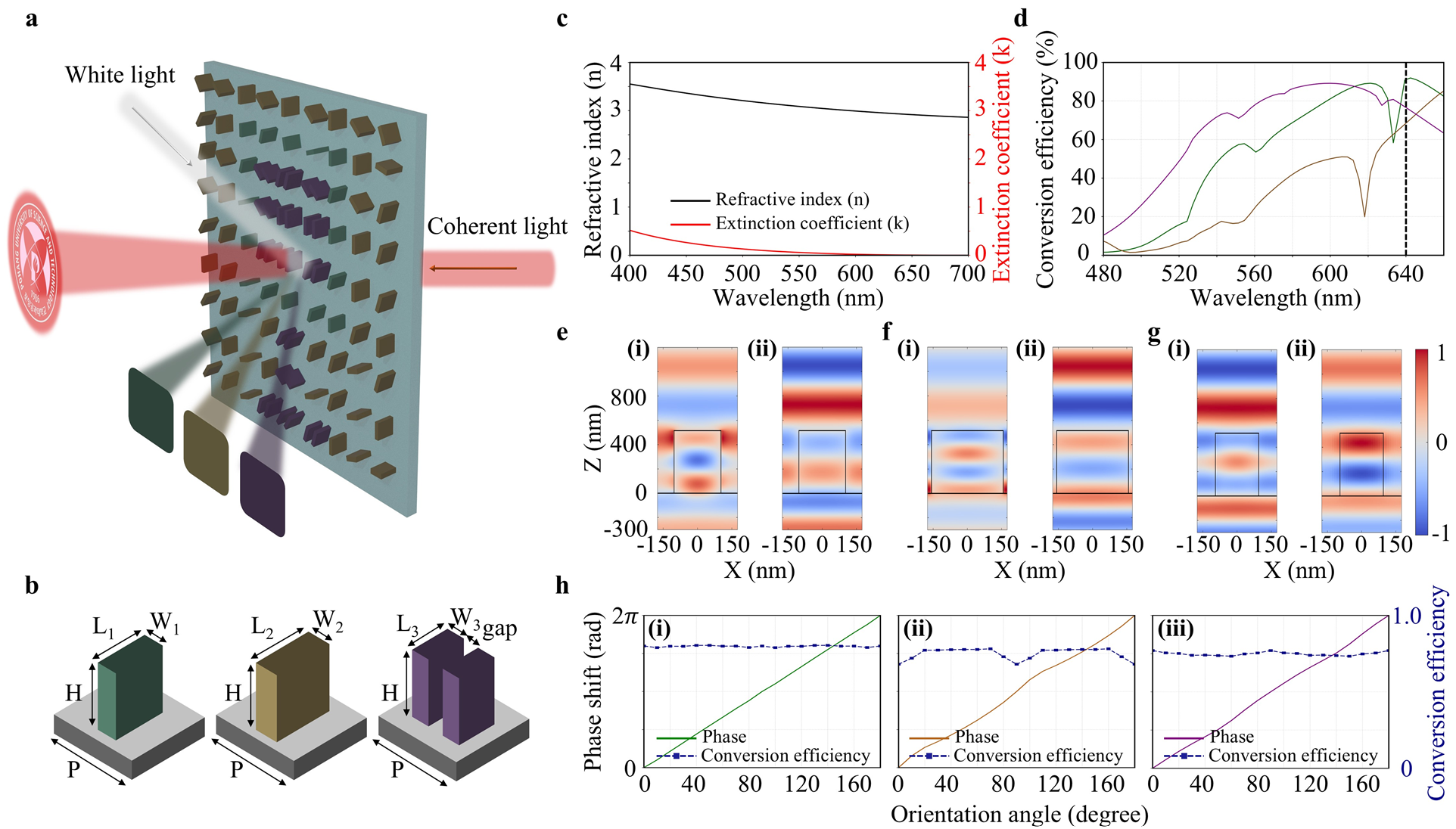

GA, UNITED STATES, August 5, 2026 /EINPresswire.com/ — Researchers from POSTECH have developed an all-dielectric single-layer metasurface that enables triple-color printing under white light and high-efficiency holography under coherent light. By engineering three distinct meta-atoms, the device achieves independent control of phase and spectral response, going beyond conventional single-functional metasurfaces. The approach provides a compact route toward integrating multiple optical functions within a single ultrathin device. This multifunctional platform enhances the potential of metasurface-based technologies for optical security, anti-counterfeiting, and information storage.
Metasurfaces are ultrathin optical devices composed of nanoscale structures that can precisely control how light behaves. By tailoring these structures, researchers have demonstrated flat optical components capable of replacing bulky lenses, filters, and holographic elements. Among their many applications, two particularly promising ones are holography, which reconstructs images by controlling the spatial phase of light, and structural color printing, in which the spectral response of metasurfaces is engineered to generate high-resolution color displays. Meta-holograms based solely on phase modulation typically lack control over spectral responses, resulting in non-distinct visual appearance under typical lighting conditions. In contrast, most color-printing metasurfaces, which rely on engineered spectral responses, do not encode the spatial phase information required for holographic image reconstruction. Although several studies have attempted to integrate color printing and holography into a single metasurface, such dual-functional designs often exhibit limited hologram efficiency, which continues to hinder practical implementation.
In a new paper published in Light: Advanced Manufacturing, a team of researchers led by Prof. Junsuk Rho from POSTECH (Pohang University of Science and Technology), Korea, report a dual-functional metasurface that achieves improved holographic efficiency while enabling structural color printing. The team designed a single-layer dielectric metasurface capable of displaying three distinct reflective colors under white light while simultaneously reconstructing broadband holographic images under coherent light. This approach opens new possibilities for compact multifunctional metasurfaces in optical security and information-encoding applications.
To achieve independent control of color and holography within a single device, the researchers employed anisotropic nanostructures operated under circularly polarized illumination. This configuration enables Pancharatnam Berry (PB) phase modulation, allowing the optical phase to be controlled through the orientation of the meta-atom without affecting its spectral response. As a result, the phase used for holography and the spectral response responsible for color printing can be controlled independently. The reflective color is determined by the size of the nanostructures, whereas the holographic phase is defined by their in-plane orientation, ensuring minimal interference between the two functions. To expand the accessible color range, the metasurface incorporates both single and double nanorod designs, providing greater flexibility in engineering distinct spectral responses.
Numerical simulations show that the optimized meta-atoms achieve conversion efficiencies of up to 90 percent at a target wavelength of 640 nanometers. Experiments confirm that the fabricated metasurfaces display vivid structural colors under white light corresponding to the three meta-atom designs and reconstruct holographic images with high efficiency under coherent light. Importantly, the holographic performance remains robust across a broad range of visible wavelengths, demonstrating broadband operation.
To further highlight the multifunctional capability of the platform, the researchers fabricated metasurfaces that integrate all three meta-atom types into a single device. These metasurfaces display multicolor printed patterns while encoding different holographic images, such as logos or text, which are revealed only under coherent illumination. This independent control of color and holography enables multiple layers of optical information to be encoded within a single metasurface, offering a compact platform for applications such as anti-counterfeiting labels, secure authentication, encrypted optical data storage, and multifunctional display technologies.
References
DOI
10.37188/lam.2026.022
Original Source URL
https://doi.org/10.37188/lam.2026.022
Funding information
This work was supported by the POSCO–POSTECH–RIST Convergence Research Center program funded by POSCO, and the National Research Foundation (NRF) of Korea funded by the Ministry of Science and ICT (RS-2022-NR067559). Additional support was provided by the POSCO Asia Fellowship, the Yuhan Foundation New Ilhan Fellowship, the China Scholarship Council (CSC), and the InnoCORE program funded by the Ministry of Science and ICT of Korea.
Lucy Wang
BioDesign Research
email us here
Legal Disclaimer:
EIN Presswire provides this news content “as is” without warranty of any kind. We do not accept any responsibility or liability
for the accuracy, content, images, videos, licenses, completeness, legality, or reliability of the information contained in this
article. If you have any complaints or copyright issues related to this article, kindly contact the author above.

Media gallery